Every Pride Flag Explained — A Complete Guide for 2026
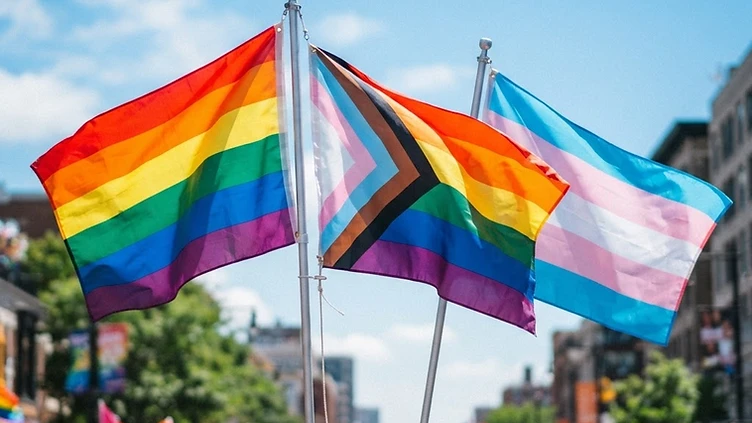
You've seen them at parades, on storefronts, stitched onto backpacks, and waving from porches across Halton Region every summer. Pride flags are everywhere — and for good reason. Each one is a small act of visibility: a way of saying we exist, we belong, and we are proud.
But with dozens of flags now representing different identities within the 2SLGBTQIA+ community, it can be hard to know what each one means, where it came from, or who designed it. This guide is here to help.
Whether you're preparing to march in a parade, decorating your home or business, educating students, or simply curious — we've put together a complete, plain-language guide to Pride flags in 2026. We start at the beginning, with Gilbert Baker and the first rainbow flag in 1978, and take you all the way through to the most recent additions to the family.
We'll be flying many of these flags at Pride Halton on July 19 in Milton. We hope to see you there.
Why Flags Matter
Before we get into the flags themselves, it's worth pausing on why they matter at all.
For most of history, 2SLGBTQIA+ people had no symbol they could claim as their own. The pink triangle — reclaimed by activists in the 1970s from the badge used to mark gay prisoners in Nazi concentration camps — was powerful but rooted in tragedy. Harvey Milk, the pioneering San Francisco supervisor and gay rights leader, wanted something different. He asked his friend Gilbert Baker to design something joyful. Something that said pride, not just survival.
Baker chose a flag because, as he later wrote, a flag is "the most powerful symbol of pride" — more than a button or a banner, a flag claims space. It says: we are here.
The flags that followed — dozens of them, designed by community members online, in bedrooms and community centres and Pride events — are extensions of that same impulse. Each one says: we are here too. Our identity has a name. And it deserves a symbol.
The Umbrella Flags: Representing Everyone
The Rainbow Pride Flag (1978)
Designer: Gilbert Baker, with volunteers Lynn Segerblom and James McNamara Debuted: San Francisco Gay Freedom Day Parade, June 25, 1978
The original. The one that started everything.
Gilbert Baker — a self-taught sewist, US Army veteran, and San Francisco activist — designed the rainbow flag at the request of Harvey Milk as a unifying symbol for the gay community. The first flags were hand-dyed and stitched by Baker and a team of thirty volunteers, and debuted at San Francisco's UN Plaza in 1978.
Baker's original design had eight stripes, each with a specific meaning he assigned himself:
- Hot pink — sex
- Red — life
- Orange — healing
- Yellow — sunlight
- Green — nature
- Turquoise — magic and art
- Indigo — serenity
- Violet — spirit
After Harvey Milk's assassination later that year, demand for the flag surged — but hot pink fabric couldn't be sourced in large quantities. The turquoise and indigo stripes were eventually merged into a single royal blue. The result is the six-stripe flag the world knows today: red, orange, yellow, green, blue, and violet.
The rainbow flag doesn't represent any single identity. It represents all of us — the full spectrum of the 2SLGBTQIA+ community, diverse and connected at once.
The Philadelphia Pride Flag (2017)
Designer: Marketing firm Tierney, commissioned by the City of Philadelphia Debuted: June 2017
In 2017, the City of Philadelphia added black and brown stripes to the top of the standard rainbow flag to explicitly represent queer and trans people of colour. The addition came after community conversations about racism within LGBTQ+ spaces and the need to centre the voices of Black, Indigenous, and racialized community members who have always been part of the movement.
Black and brown — recognition and inclusion of LGBTQ+ people of colour
The Philadelphia flag sparked important conversations across the community about who gets centred in Pride spaces, and laid the groundwork for the Progress Pride Flag.
The Progress Pride Flag (2018)
Designer: Daniel Quasar Debuted: 2018
Designer Daniel Quasar took the rainbow flag and the Philadelphia additions one step further, incorporating the colours of the transgender flag (white, pink, and blue) into a chevron on the left side, alongside the black and brown stripes for LGBTQ+ people of colour. The arrow shape points forward — representing progress, momentum, and the work still to be done.
The chevron includes:
- White, pink, blue — trans and non-binary inclusion
- Brown and black — people of colour
This flag is now the most commonly used Pride flag at large events and organizations, including many Canadian institutions.
The Intersex-Inclusive Progress Pride Flag (2021)
Designer: Valentino Vecchietti of Intersex Equality Rights UK Debuted: 2021
The most recent major evolution of the community-wide umbrella flag. Vecchietti added a yellow triangle with a purple circle — drawn from the Intersex Pride Flag — to the Progress Pride design. This flag is now the most broadly inclusive umbrella flag for the 2SLGBTQIA+ community as a whole.
Intersex addition:
- Yellow — a colour deliberately chosen to contrast gendered associations of pink and blue
- Purple circle — unbroken and complete, representing bodily autonomy and the wholeness of intersex people
Sexuality Flags
The Bisexual Pride Flag (1998)
Designer: Michael Page Debuted: December 5, 1998
Designed to increase visibility of the bisexual community within both LGBTQ+ spaces and broader society. The bisexual community has long faced erasure — the assumption that bisexuality isn't a "real" orientation — and Page created the flag as a direct response.
- Pink (top, wide) — attraction to the same gender
- Blue (bottom, wide) — attraction to a different gender
- Purple (centre, narrow) — attraction to two or more genders; the overlap between them
The Lesbian Pride Flag
Several designs have circulated over the years. The most widely adopted modern version features horizontal stripes in shades of orange, white, and pink/magenta, representing the diversity of lesbian identity and a move away from older symbols that many found exclusionary. Community adoption has made it the de facto standard at most Pride events today.
The Gay Men's Pride Flag
Commonly used version: Featuring shades of green, teal, blue, and white
Several designs have been proposed over the years. The current most widely used version — featuring shades of green and blue — was developed to move away from the blue-dominant designs that many felt leaned too heavily into stereotypical gender colour coding.
The Pansexual Pride Flag (c. 2010)
Designer: Unknown (originated online) Debuted: Approximately 2010
Pansexuality refers to emotional, romantic, or sexual attraction to people regardless of gender.
- Pink — attraction to women and femininity
- Yellow — attraction to non-binary, genderqueer, and gender-nonconforming people
- Blue — attraction to men and masculinity
The Asexual Pride Flag (2010)
Designer: Created by community vote on AVEN (Asexual Visibility and Education Network) Debuted: August 2010
Asexuality describes a spectrum — from people who experience no sexual attraction, to those who experience it rarely or only in specific contexts.
- Black — asexuality
- Grey — the grey-asexual and demisexual spectrum
- White — non-asexual partners and allies
- Purple — community
Gender Identity Flags
The Transgender Pride Flag (2000)
Designer: Monica Helms, US Navy veteran and trans activist Debuted: 2000
Monica Helms designed the transgender flag so that no matter which way it flies, it reads correctly — symbolizing the community's search for correctness and balance in their own lives.
- Light blue — traditional baby boy colour
- Pink — traditional baby girl colour
- White — those who are transitioning, intersex, or consider themselves having a neutral or undefined gender
The Non-Binary Pride Flag (2014)
Designer: Kye Rowan Debuted: 2014
Created by 17-year-old Kye Rowan to represent non-binary people who felt the genderqueer flag didn't represent them.
- Yellow — something outside the gender binary
- White — all genders
- Purple — a mix of genders
- Black — lack of gender
The Genderfluid Pride Flag (2012)
Designer: JJ Poole Debuted: 2012
- Pink — femininity
- White — all genders
- Purple — a mix of masculinity and femininity
- Black — lack of gender
- Blue — masculinity
The Genderqueer Pride Flag (2011)
Designer: Marilyn Roxie Debuted: 2011
- Lavender — androgyny, a mix of pink and blue
- White — agenderness
- Green — non-binary identities outside the gender binary
Additional Identity Flags
The Intersex Pride Flag (2013)
Designer: Organisation Intersex International Australia Debuted: 2013
- Yellow — deliberately chosen as a colour separate from the gender binary
- Purple circle — unbroken, symbolizing wholeness and completeness
The Two-Spirit Flag
Two-Spirit is an umbrella term used by some Indigenous North American communities to describe gender and sexual diversity. The flag incorporates elements from both Indigenous and 2SLGBTQIA+ symbolism.
The Agender Pride Flag
- Black and white — the absence of gender
- Grey and green — non-binary identities
Fly Your Colours
Every flag in this guide represents real people, real communities, and real histories. Whether you fly one, fly several, or fly the umbrella flag that represents us all — the message is the same: we are here, we are proud, and we belong.
We'll be flying many of these flags at Pride Halton on July 19 in Milton. Come join us.
Related Stories

Pride Parade 2027 — Date, Route & Details for Milton, Ontario
Planning ahead for the Pride Halton Parade in 2027? Here's everything we know so far about the 2027 Pride parade in Milton, Ontario — expected date, parade route, Pride in the Park festival, and how to get involved.
IUOE Local 793 Joins Pride Halton as Parade Partner; Milton Ford Named Friend of Pride Sponsor
Pride Halton is pleased to announce that the International Union of Operating Engineers (IUOE) Local 793 will join as an official parade partner in this year's Pride celebrations on July 19 in Milton while Milton Ford will also join as a Friend of Pride Sponsor.

Why does Pride Halton celebrate Pride in July?
We know what you're thinking: Hello? Pride Month is in June…so why is Pride Halton's Parade in July?