Why Pronouns Matter: A Simple Guide for Everyday Respect
Pronouns are one of the simplest, most powerful ways to show respect for someone's identity. Using the right pronouns is a small act that makes a big difference in making people feel seen and valued.
What are pronouns?
Pronouns are the words we use to refer to people when we're not using their name. The most common pronouns are:
- she/her/hers — typically used by women
- he/him/his — typically used by men
- they/them/theirs — used by some non-binary, genderfluid, or agender people, and also as a singular pronoun when you don't know someone's pronouns
Some people use neopronouns like ze/zir/zirs or xe/xem/xyr, and some people use a combination of pronouns, like she/they. There's no one-size-fits-all.
Why do pronouns matter?
When you use someone's correct pronouns, you're telling them: I see you, I respect you, and you belong here. It's a simple affirmation that costs nothing but means everything.
When you use the wrong pronouns — especially intentionally — you're sending the opposite message: I don't see you for who you are, and I don't respect your identity. For trans, non-binary, and gender-diverse people, being misgendered can be deeply hurtful. It can happen anywhere: at work, at school, at the doctor's office, in a coffee shop. And it happens often.
Research shows that using a young person's correct name and pronouns significantly reduces their risk of depression and suicide. That's how powerful this small act is.
How to get it right
1. Share your own pronouns
When you introduce yourself, include your pronouns: "Hi, I'm Matthew, I use he/him." This normalizes the practice and creates space for others to share theirs. Adding pronouns to your email signature, social media bio, or name tag is a simple way to show allyship.
2. Ask, don't assume
If you're not sure what pronouns someone uses, it's okay to ask. You can say: "What pronouns do you use?" or "Can I ask what pronouns you go by?" Most people will appreciate the question — it shows you care.
3. Practice
If you've known someone by one set of pronouns and they've asked you to use different ones, it can take time to adjust. That's normal. The key is to keep trying. If you make a mistake, correct yourself, apologize briefly, and move on. Don't make a big deal out of it — just get it right next time.
4. Use "they" when you don't know
If you don't know someone's pronouns, use "they/them" as a singular pronoun. This is grammatically correct (it's been used in English for centuries) and it avoids making assumptions based on appearance.
5. Correct others
If you hear someone use the wrong pronouns for a person — especially when that person isn't in the room — gently correct them. A simple "Actually, Alex uses they/them" goes a long way.
Common misconceptions
"It's too hard to remember"
If you can remember someone's name, you can remember their pronouns. It might take practice, but it gets easier. And the effort shows that you care.
"They/them is grammatically incorrect"
Singular "they" has been used in English since the 1300s. You probably already use it: "Someone left their umbrella — I hope they come back for it." It's correct, natural, and widely accepted.
"Pronouns are a new trend"
People have been expressing gender diversity throughout human history. Many cultures have long traditions of people who exist outside the gender binary. What's new is the language we're using to talk about it — and the growing social acceptance of letting people define themselves.
Pronouns at Pride Halton
At Pride Halton events, you'll see pronoun buttons, pronoun stickers, and pronoun fields on registration forms. We do this because we want every person who walks through our doors to feel welcome and respected. We also ask our volunteers, board members, and performers to share their pronouns — because leadership means modeling the behaviour we want to see.
Our founder, Melanie Tremills, uses she/her. Our Chair, Matthew George, uses he/him. And we ask everyone in our community to do the same simple thing: respect each other's pronouns.
A small act, a big impact
Using someone's correct pronouns is one of the easiest ways to be an ally. It takes almost no effort, but it can make someone's day — or even change their life. So the next time you meet someone new, ask: "What pronouns do you use?" You might be surprised by how much it means.
Happy International Pronouns Day from Pride Halton. Let's keep making space, together.
Related Stories

Pride Events in Milton, Ontario — Your Complete 2027 Guide
Looking for Pride events in Milton, Ontario? From the annual Pride Halton parade down Main Street to Pride in the Park at the Fairgrounds, flag raisings, and year-round PRIDE365 programming — your complete guide to Pride in Milton.

LGBTQ2S+ Resources in Halton Region — Support, Health & Community Services
If you're looking for LGBTQ2S+ resources in Halton Region, this guide brings together the support services, community groups, healthcare providers, and crisis lines available across Milton, Burlington, Oakville, and Georgetown.

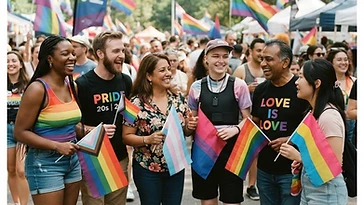
Pride Events 2026 — Celebrate Across Ontario Before (and After) Pride Halton
Pride season in Ontario is something truly special. From late May through September, 2SLGBTQIA+ communities across the province come alive with parades, festivals, drag performances, family events, and moments of pure joy.